ENG 201: Monsters and Marvels in the Middle Ages
Spring 2021, Online
In this course we will explore the contours of the medieval imagination as it made sense of the world in a variety of literary and historical texts from the sixth through the fourteenth centuries. We will focus on the function of marvels and monsters as plot devices, as ways of representing cultural anxieties, and as modes of construing the relationship between self and “Other” and between the natural world and the social world. This course counts toward the English Department's pre-1700 requirement.
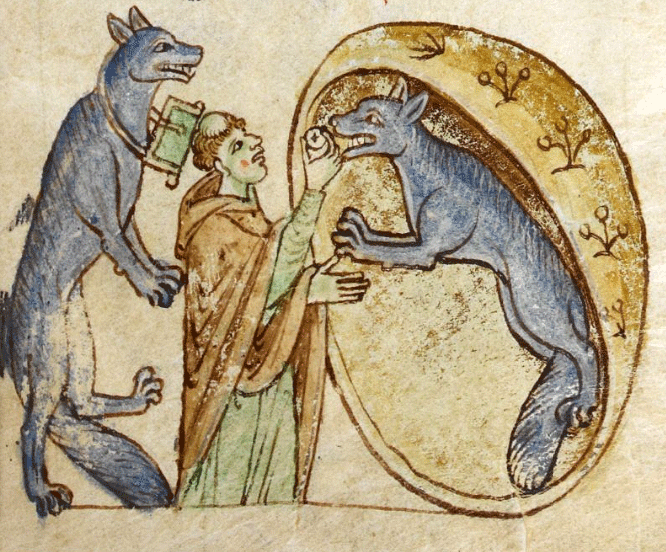
A priest offers the Eucharist to the famous werewolves of Ossory. We do not recommend trying this at home.
Required Texts
The Gryphon hails all its Reed College friends.
Learning Outcomes
Course Policies
Resources
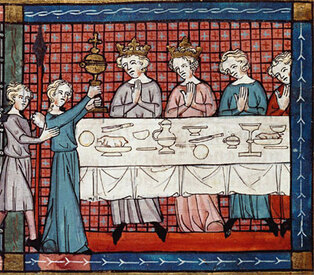
The Grail procession (from a 13th-cent. French manuscript)
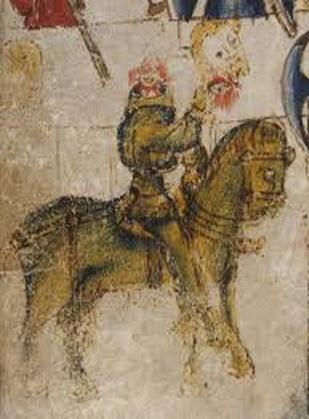
The Green Knight, atop green horse, using his head
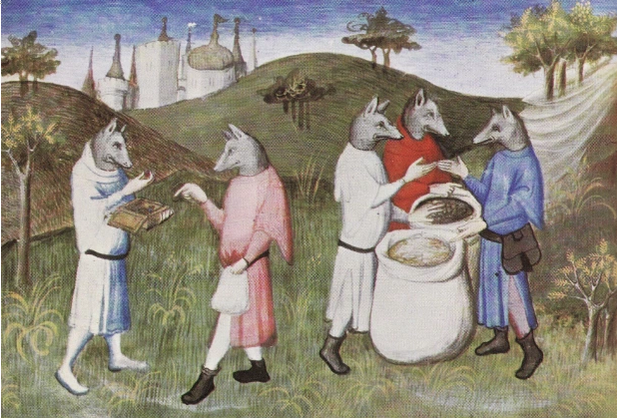
Neither werewolves nor talking dogs, the canine-headed Cynocephali are humans who live ... elsewhere
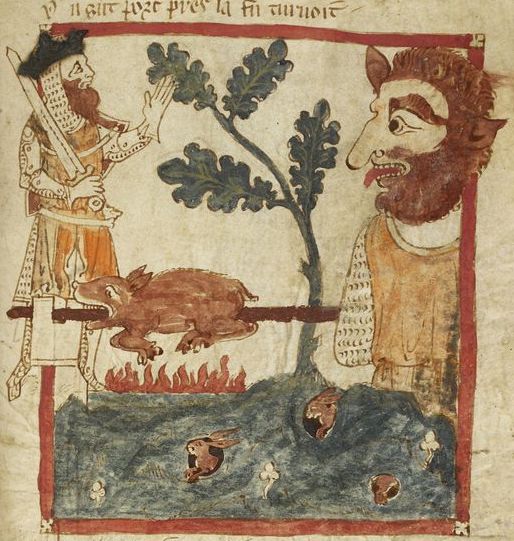
King Arthur (the one on the left, with the sword) encounters the infamous giant of Mont-St-Michel (the one with his tongue out on the right), with rabbits in the foreground, trying to remain as inconspicuous as possible.
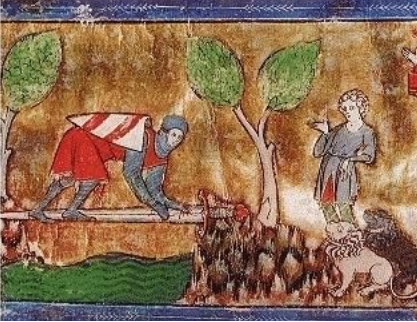
Lancelot gingerly crosses the aptly named Sword Bridge.
|
Schedule of Readings
Week One M Jan 25: Ideas of order and disorder in the Middle Ages; Isidore of Seville (PDF)
W Jan. 27: Augustine of Hippo, excerpts from The City of God (16.4-9, 21.4-8)(PDF); Valerie I. J. Flint, “Monsters and the Antipodes in the Early Middle Ages” (PDF); Jacques LeGoff, “The Marvelous in the Medieval West” (PDF)
F Jan. 29: The Letter of Alexander to Aristotle (PDF); Jeffrey Jerome Cohen, “Monster Culture (Seven Theses)” (PDF) Week Two M Feb 1: Beowulf (read at least to line 1000)
W Feb. 3: Beowulf (read at least to line 2000); and read “Grettir the Strong and the Trollwoman” (in the Norton edition, pp. 86-89) F Feb. 5: Beowulf (finish it); J. R. R. Tolkien, “Beowulf: The Monsters and the Critics” (in the Norton edition, pp. 103-130) Week Three M Feb. 8: Beowulf; Jane Chance, “The Structural Unity of Beowulf: Grendel’s Mother” (in the Norton edition, pp. 152-167) W Feb. 10: The Táin, introduction and pp. 1-50 F Feb. 12: The Táin, pp. 51-167 Week Four M Feb. 15: The Táin, pp. 168-253; and “Fergus and the Cosmogonic Sword” (JSTOR) W Feb. 17: The Táin (reprise); and Joan Radner, “Fury Destroys the World” (PDF handout) F Feb. 19: Class canceled today, but do start reading The Book of Beasts, pp. 7-229. And feel free to skip any or all of the footnotes. Week Five M Feb. 22: The Book of Beasts, pp. 7-229 W Feb. 24: Gerald of Wales, The History and Topography of Ireland (all) F Feb. 26: Gerald of Wales, The History and Topography of Ireland; and Rhonda Knight, "Werewolves, Monsters, and Miracles: Representing Colonial Fantasies in Gerald of Wales's Topographia Hibernica" (JSTOR) Week Six M Mar 1: Marie de France, Prologue and Guigemar (in The Lais of Marie de France, pp. 48-99)
W Mar. 3: Marie de France, Bisclavret (pp. 144-161) F March 5: Marie de France, Yonec and Milun (pp. 210-239 and 250-277) Week Seven M March 8: Marie de France, Lanval (pp. 163-195); Aisling Byrne, "Otherworld Excess and the Perils of Desire" (PDF) W March 10: Class canceled. No reading, nothing due. F March 12: Marie de France, Guildelüec and Guilliadun (pp. 111-126) Week Eight M March 15: Chrétien de Troyes, Yvain, pp. 295-328
W March 17: Chrétien de Troyes, Yvain, pp. 329-358 F March 19: Chrétien de Troyes, Yvain, pp. 359-380; Jacques LeGoff, “Levi-Strauss in Broceliande” (PDF) Week Nine M March 22: Chrétien de Troyes, Lancelot, pp. 207-225 W March 24: Chrétien de Troyes, Lancelot, pp. 226-265 F March 26: Respite and Recharge Week Ten M March 29: Chrétien de Troyes, Lancelot, pp. 266-294 W March 31: Chrétien de Troyes, The Story of the Grail, pp. 381-425 F Apr. 2: Chrétien de Troyes, The Story of the Grail, pp. 425-460 Week Eleven M Apr. 5: Chrétien de Troyes, The Story of the Grail, pp. 460-494 W Apr. 7: Sir Orfeo [please access text in translation here: http://sites.fas.harvard.edu/~chaucer/special/litsubs/breton/orfeo.html] F Apr. 9: Sir Gawain and the Green Knight, Fitt One
SPRING BREAK: APRIL 10-18 Week Twelve M Apr. 19: Sir Gawain and the Green Knight, Fitt Two W Apr. 21: Sir Gawain and the Green Knight, Fitt Three F Apr. 23: Sir Gawain and the Green Knight, Fitt Four; Geraldine Heng, "Feminine Knots and the Other Sir Gawain and the Green Knight" (JSTOR) Week Thirteen M Apr. 26: The Travels of Sir John Mandeville, pp. 43-99 W Apr. 28: The Travels of Sir John Mandeville, pp. 99-149; Martin Camargo, "The Book of John Mandeville and the Geography of Identity" (PDF) F Apr. 30: The Travels of Sir John Mandeville, pp. 150-190 |
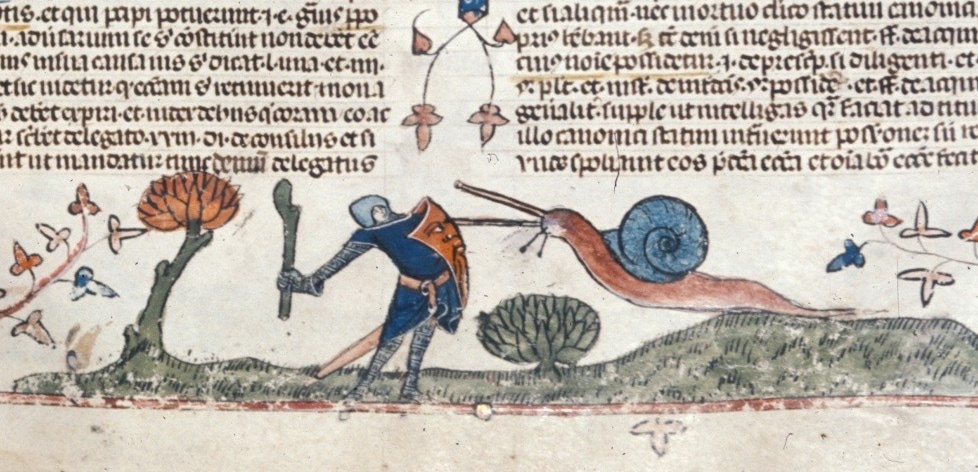
That snail's got a mean streak a mile wide!
